

Quick Answers
Where is the Cathedral Fig Tree?
In Danbulla National Park near Lake Tinaroo, a short walk from the Danbulla Forest Drive, about 90 minutes from Cairns.
How old is the Cathedral Fig Tree?
About 500 years.
What is a strangler fig?
A fig that starts as a seed high in a host tree and sends roots down to the ground. When the host dies, a huge lattice of roots remains.
“You hear about the Cathedral Fig before you see it. And then you see it, and everything you heard seems like an understatement.”
The Cathedral Fig Tree: One of the Great Living Wonders of Far North Queensland
In the rainforest near Yungaburra, off a short track from the main road, stands one of the most extraordinary living things in Australia — the Cathedral Fig, a massive strangler fig of such scale and presence that the first sight of it tends to produce silence. Not reverent silence exactly, though that feeling comes. Simply the silence of encountering something that makes ordinary language feel inadequate.
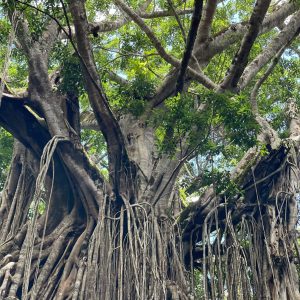
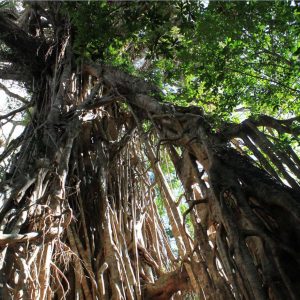
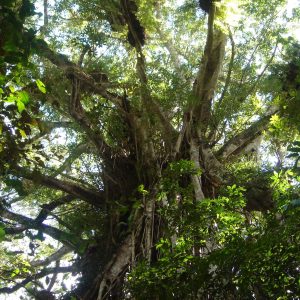
The Cathedral Fig began its life as a seed dropped by a bird in the canopy of another tree, possibly 500 years ago. As a strangler fig, it sent roots downward to the ground and then gradually enclosed its host tree in an ever-tightening network of aerial roots. The host tree eventually died and rotted away, leaving the fig’s interlocking root system as a living structure of extraordinary complexity — a hollow, room-sized cavity surrounded by a lattice of thick roots, arching upward to a canopy that shades a wide area of forest floor.
The tree stands around 50 metres tall and has a canopy spread of more than 40 metres. Its root system is the defining experience — you can stand inside the cathedral-like space formed by the roots and look up through a green-filtered light that genuinely earns the tree its name. Visitors often describe feeling something in front of the Cathedral Fig that they struggle to articulate — a sense of being in the presence of something ancient and completely indifferent to time.
The Cathedral Fig is accessible via a short, sealed walking track. A visit takes around 20 minutes return and can be combined easily with a visit to the nearby Curtain Fig Tree, which offers a completely different but equally extraordinary experience.
A Hot Getaways destination. Where Care is Our Compass.
Cathedral Fig Tree FAQs
Where is the Cathedral Fig Tree?
The Cathedral Fig Tree is in Danbulla National Park near Lake Tinaroo, north of Yungaburra, reached by a short walk from the Danbulla Forest Drive, about a 90-minute drive from Cairns.
How old is the Cathedral Fig Tree?
The Cathedral Fig is estimated to be around 500 years old. It is one of the largest and most impressive strangler figs in Far North Queensland.
What is a strangler fig?
A strangler fig begins life as a seed dropped high in a host tree, sending roots down to the ground and gradually enclosing the host. When the host tree dies and rots away, the fig interlocking aerial roots remain as a huge living structure.
Is the Cathedral Fig Tree free to visit?
Yes. The Cathedral Fig Tree is free to visit, with a car park and a short, easy walking track leading to a viewing platform at the base of the tree.
Can you combine the Cathedral Fig with other attractions?
Yes. The Cathedral Fig sits along the Danbulla Forest Drive around Lake Tinaroo, so it pairs well with the lake, Lake Euramoo and the drive scenic lookouts.
Travel Kindly
At Hot Getaways, care is our compass — and a little kindness makes every journey better. When you visit the Atherton Tablelands, we gently ask you to:
- Tread lightly — stay on tracks and lookouts, and take special care around waterfalls, which can be slippery and swift.
- Respect the wildlife — never feed the platypus, tree-kangaroos or birds, and observe them quietly from a distance.
- Support local — choosing local operators, cafés and guides helps this beautiful place thrive.
- Honour Country — we travel on the traditional lands and sea Country of Australia’s First Peoples, with gratitude and respect to the Traditional Custodians past and present.
- Be kind to each other — a smile, a little patience and a helping hand make the day lovelier for everyone.
Small acts of care add up to something wonderful. Thank you for travelling kindly.