

Quick Answers
What makes Victoria’s riflebird special?
The male is velvety black with an iridescent blue-green throat. He spreads his wings into an oval and sways to impress females.
When is the best time to see one?
The breeding season, August to December, when males display at traditional perches.
Where should I look?
Mature rainforest with large fig trees and a dense canopy. Local birdwatching guides know the display sites.
Book the Tablelands Exclusive Wildlife and Nature Private Tour →
“The male Victoria’s Riflebird spreads his wings on the display perch, throws back his head, and performs — the iridescence of his plumage catching the light in a way that the eye can barely follow.”
Victoria’s Riflebird: The Tablelands’ Bird of Paradise
Victoria’s Riflebird is one of Australia’s most spectacular birds — a member of the bird of paradise family (Paradisaeidae) whose extraordinary display has to be seen to be properly understood. The male is a large, velvety black bird with iridescent blue-green plumage on the throat and breast that, in the right light, catches and throws colour in a way that seems almost unnatural. The display he performs to attract females involves spreading his wings into a perfect oval, swaying rhythmically, and throwing his head back to reveal the maximum extent of his iridescent throat — a performance of considerable drama.
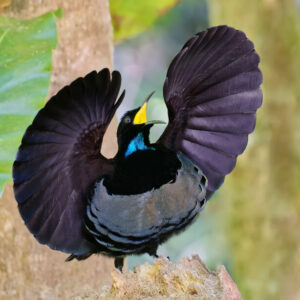

Victoria’s Riflebirds are found in the upland tropical rainforests of Far North Queensland, where they are permanent residents in the forest from sea level to around 1,500 metres. The Atherton Tablelands is prime territory — the dense, mature rainforest and reliable fruiting trees provide ideal habitat. Males are most visible and active during the breeding season from August to December, when displaying males can be found at traditional perches in the forest.
The female is an entirely different-looking bird — brown and streaked, far less conspicuous — and spends much of the year in the forest understorey, visiting male display trees to assess potential mates. Finding and watching a displaying male Victoria’s Riflebird is one of the genuine birdwatching highlights of the Atherton Tablelands.
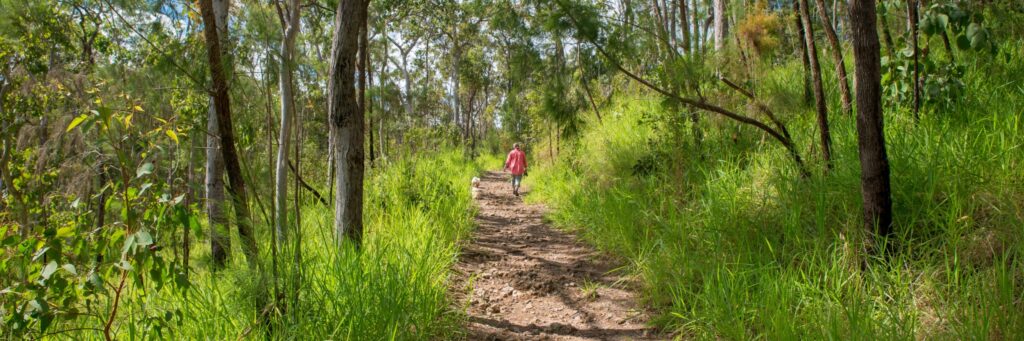 Walking Trails
 Atherton Tablelands Waterfalls
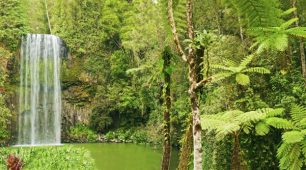 Things to Do
 Atherton Tablelands Tours
Local birdwatching guides can locate known display sites during the breeding season. Independent sightings are most likely in mature rainforest areas with large fig trees and dense canopy cover — the areas around Lake Eacham, Lake Barrine, and the upland forests between Yungaburra and Millaa Millaa are all worth searching.
A Hot Getaways destination. Where Care is Our Compass.
Travel Kindly
At Hot Getaways, care is our compass — and a little kindness makes every journey better. When you visit the Atherton Tablelands, we gently ask you to:
- Tread lightly — stay on tracks and lookouts, and take special care around waterfalls, which can be slippery and swift.
- Respect the wildlife — never feed the platypus, tree-kangaroos or birds, and observe them quietly from a distance.
- Support local — choosing local operators, cafés and guides helps this beautiful place thrive.
- Honour Country — we travel on the traditional lands and sea Country of Australia’s First Peoples, with gratitude and respect to the Traditional Custodians past and present.
- Be kind to each other — a smile, a little patience and a helping hand make the day lovelier for everyone.
Small acts of care add up to something wonderful. Thank you for travelling kindly.